
Submittals: Too Important to Get Wrong
Article Takeaways
Submittals are a safeguard against assumptions when ordering highly customizable, technical products. Missing one detail can mean steep restocking fees and significant project delays.
A cut sheet is not a submittal, and a submittal is only useful when the right technical questions have been asked and answered.
Involving the technical product experts helps ensure the details are clearly defined before the product is approved and ordered.
Submittals aren’t always required, but they’re always a good idea when ordering technical products.
Too Much At Stake for Assumptions
With technical products, the smallest incorrect detail can have dramatic consequences for both project timing and cost. When the wrong product arrives onsite, high restocking fees are only the beginning. The correct product still has to be ordered, which resets lead times and can disrupt the entire project schedule. These problems are compounded if the product has already been installed or isn’t identified until inspection.
When the submittal process is skipped, rushed, or handled without the right expertise, important clarifying questions don’t get asked, and timelines and budgets become less reliable.
So, where do things most often go wrong?
A Cut Sheet Is Not a Submittal
One of the biggest problems we see is when customers mistake “cut sheets” for submittals. Cut sheets (also sometimes called E-sheets or engineering data sheets) are generic product info sheets that contain a range of sizes, tolerances, and optional features for a particular product or family of products. These are useful to engineers during the design phase to understand capabilities, compare options, and calculate hydraulics. A cut sheet shows what’s possible, but does not establish exactly what should be ordered.
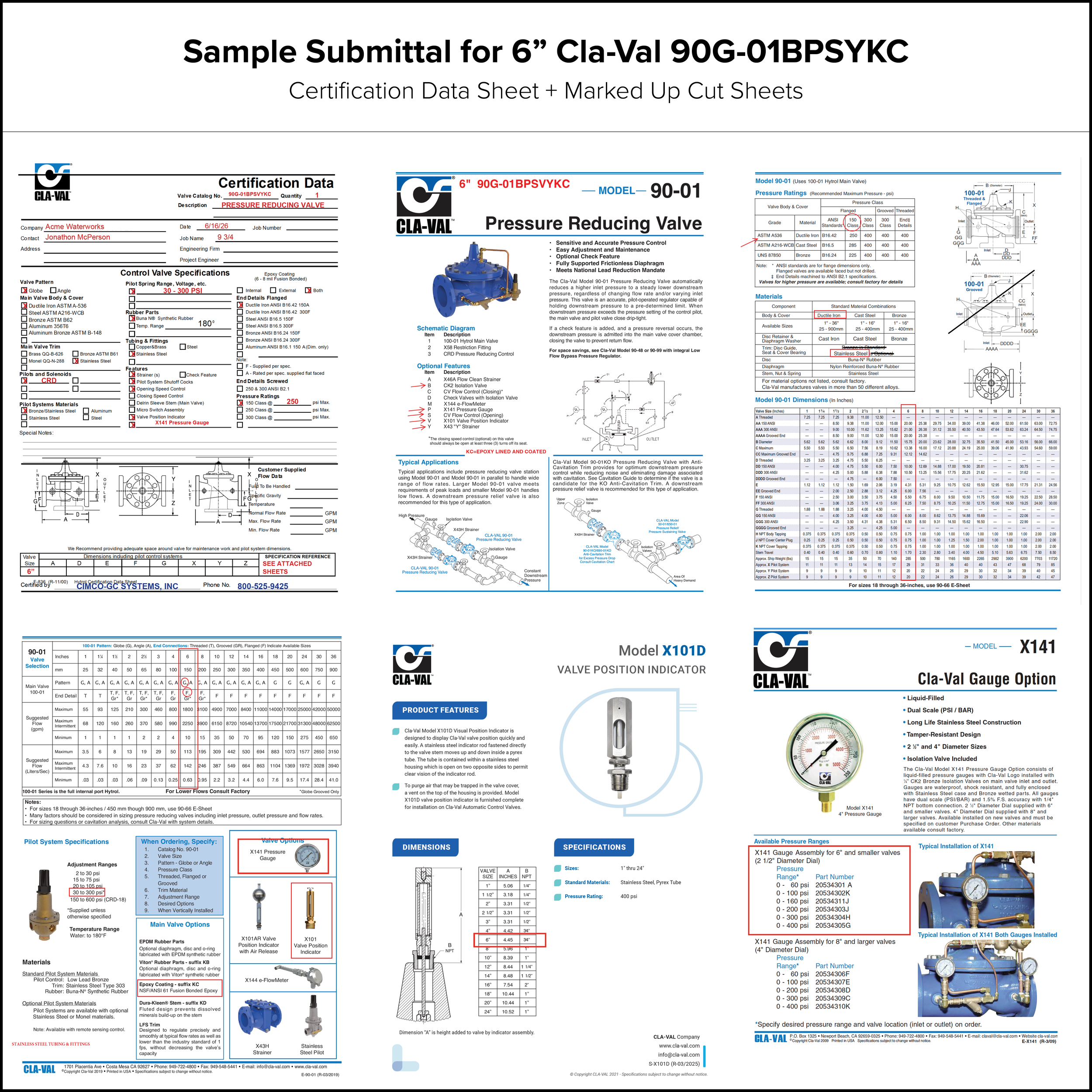
A submittal documents the exact model, dimensions, features, options required for a specific application, sometimes including special installation instructions. It is marked up so that the intended selections are explicit, providing a clear reference for engineer approval and order placement.
This is an important distinction, because when an unmarked cut sheet is used in place of a submittal, unspecified selections are left to assumption or may default to standard options. A properly prepared submittal documents exactly what should be ordered, built, and installed to function as intended.
Share the Technical Load
A good submittal addresses the questions that need to be answered before a product is ordered. And that’s the second problem we see: sometimes submittals are prepared by someone who doesn’t know the right questions to be asked. That’s why it’s important to involve technical experts in the process.
A good submittal process depends on each project partner doing their part:
Engineer’s Role: Establish the design requirements, then review and approve the submittal to confirm that the proposed product matches the design intent. Work with the manufacturer or representative to clarify any missing or incorrect information.
Distributor’s Role: When the project has been awarded and the order is ready to be placed, request submittals from the manufacturer or representative. Provide accurate submittals for all products being supplied and send to the engineer for review and approval before ordering.
Cimco-GC’s Role: Carry the technical load for the products we represent. We know the products, available options, and the questions that need to be asked. We prepare product-specific submittals, identify missing information, clarify details, and work with engineers to confirm their intentions and how the products are expected to perform in the field.
Providing accurate submittals for every product being supplied is a significant responsibility. Our distributors don’t have to take on that technical burden alone. Lean on our team for the product expertise and documentation needed to support the approval process. When each party treats the process as a meaningful technical review, the submittal becomes a source of confidence rather than just another paperwork requirement.
“Yes, that’s exactly what we wanted.”
Even when a project doesn’t formally require a submittal, we recommend requesting one. There’s too much at stake to leave the details of a technical product to assumption.
Our goal is simple: make sure the customer gets exactly what they intended to get. As the manufacturer’s representative, we know the product, the options, and the questions that need to be asked. Lean on our team to clarify the details and give the engineer exactly what they need to confidently approve the product before it’s ordered.
The next time you’re working on a project, help ensure you get exactly what you need by requesting a submittal.